
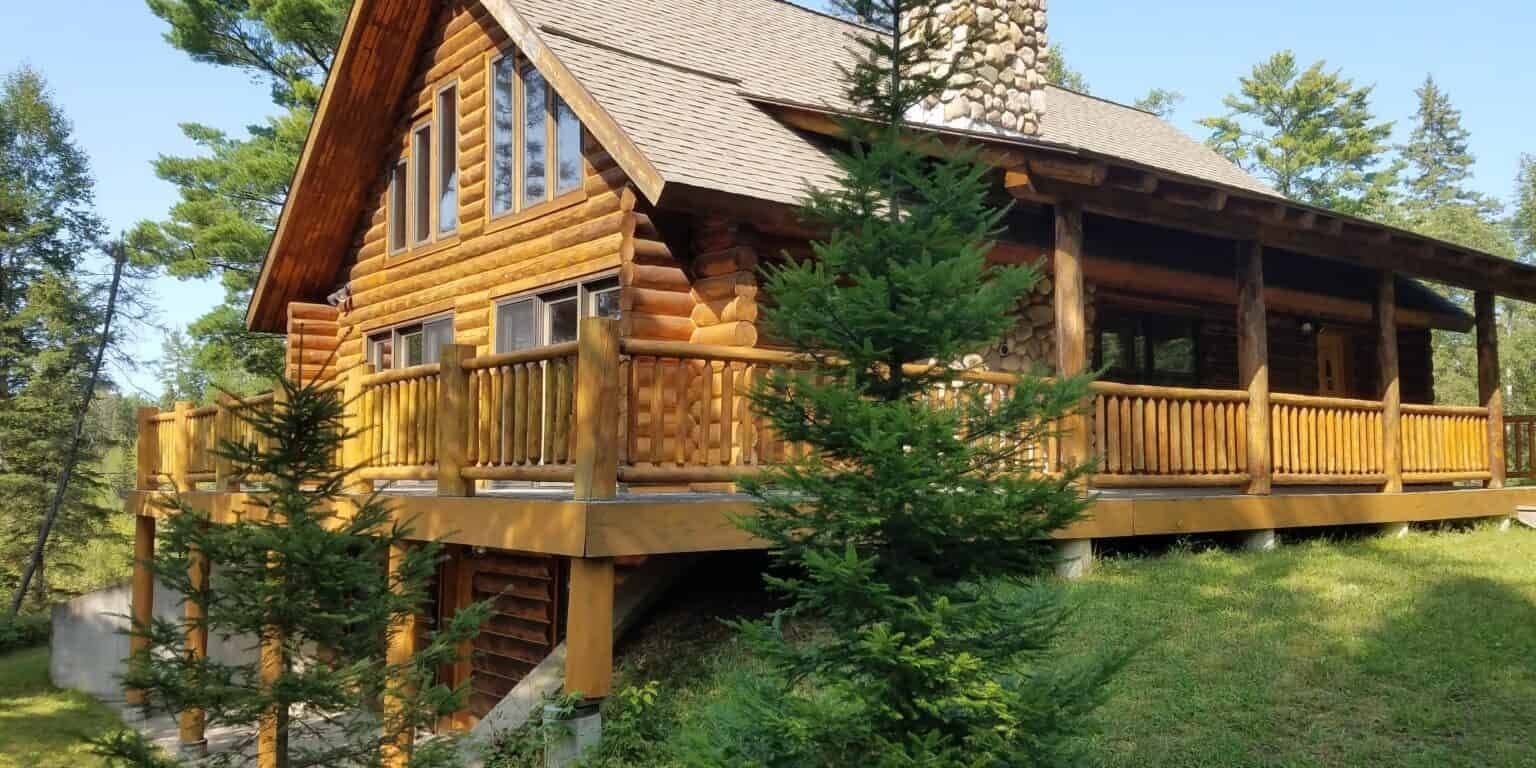
Log Cabin Chinking Services in Northern Michigan and the Upper Peninsula
Flexible Protection for the Gaps Between Your Logs
Chinking seals the spaces between logs to help protect your cabin from drafts, moisture, and seasonal movement. In Northern Michigan, the Upper Peninsula, and Northern Wisconsin, that matters. The humidity and weather in the Great Lakes can wear down the joints between logs over time.
WEATHERWIZE Log Home Professionals provides log cabin chinking as part of routine log home maintenance and restoration. When done properly, chinking helps protect your logs, improve comfort, and keep small gaps from becoming bigger problems.
What Log Cabin Chinking Is Made Of and Why It Matters
Older chinking was often made from rigid materials like mortar, clay, or cement-based mixtures. These materials blocked drafts, but they couldn’t move with the logs. As wood expanded, contracted, and settled, rigid chinking often cracked or pulled away.
Modern elastomeric chinking is designed to flex with seasonal movement while staying bonded to the log surface. That flexibility is especially important in Northern Michigan and the Upper Peninsula, where temperature and moisture swings are constant.
WEATHERWIZE uses trusted chinking products from Sashco and Perma-Chink because they stretch, move, and hold up better than old, rigid mixtures.
Chinking and caulking are related, but they are used differently:
Chinking: Fills wider gaps between log courses, often from one inch to several inches.
Caulking: Seals smaller joints, checks, seams, window and door openings, and other narrow gaps.
The WEATHERWIZE Chinking Process
Chinking may look like a finishing detail, but it plays an important role in protecting the structure. Here’s how our process works:
Inspection & Preparation: We inspect the existing chinking, identify failed sections, check nearby logs for moisture issues, and prepare the surfaces for proper bonding.
Backing Material Installation: For wider gaps, we install backer rod or foam backing to control depth, support flexibility, and prevent improper bonding.
Chinking Application: We apply elastomeric chinking in consistent layers, bonding it to both log faces while allowing the material to move as the logs expand and contract.
Tooling & Finishing: We smooth and shape the chinking so it presses firmly against the log edges, creating a clean, finished line.
Cleanup & Final Inspection: We clean the area and point out any nearby issues, such as failing caulk, moisture staining, or soft wood, that may need attention.
When Chinking Needs Attention
Chinking wears down gradually, so early signs can be easy to miss, especially at second homes or seasonal cabins. A small separation may not seem urgent, but once air and moisture get behind the chinking, damage can spread.
Watch for:
Visible cracks along the chinking line
Gaps where chinking has pulled away from the logs
Drafts near exterior walls
Moisture stains or discoloration around chinking
Soft, darkened, or damaged wood near failed sections
Northern Michigan weather can make these problems worse. Heavy snow, freeze-thaw cycles, and prolonged humidity all stress the seal between logs. When failed chinking is ignored, moisture can enter the wall system, reduce comfort, affect insulation, and eventually damage the logs.
Chinking for Historic & Older Log Cabins
Historic log structures present different challenges than new construction. Log profiles vary, original fill materials may remain, and wood has undergone decades of movement. This work requires knowledge of materials and an understanding of how historic log buildings were constructed.
We assess the original chinking conditions, select compatible modern materials, and apply them to preserve, rather than damage, the structure. For cabins with significant historic preservation needs, our historic log home preservation services cover that broader scope.
Chinking as Part of a Broader Log Home Maintenance Plan
Chinking works best when the surrounding envelope is equally well maintained. After chinking, owners often benefit from air sealing to address gaps that chinking doesn't cover. Log home staining and sealing protect wood from UV and moisture. Flashing and splash-proofing handles transition points where water concentrates. Thermal imaging locates air and moisture movement before visible damage occurs.
For cabins with existing structural deterioration, our log home restoration services address what maintenance alone cannot.
Areas We Serve
We serve log home owners across Northern Michigan, the Upper Peninsula, and Northern Wisconsin, including Marquette, Munising, Escanaba, Iron Mountain, Petoskey, Traverse City, and Gaylord. We frequently work in Marquette, MI; Munising, MI; and Petoskey, MI. Our service area page lists our complete coverage.
Request a Free Quote
Featured Customer Review
Weatherwize did a great job. They got the job done within the time period they said they would. And the quality of their work was excellent. The guys are pleasant and professional. If you hire WeatherWize I doubt you will be disappointed.
Blog Posts
One of the most common questions we hear from homeowners is, “What does log repair cost?”
It is a fair question. Log homes are beautiful, valuable, and built to last, but when decay, water damage, failed finishes, or structural problems show up, the repair process can be more involved than many homeowners expect...
Maintaining a log home is essential to preserving its natural beauty, structural integrity, and value over time...
Maintaining a log home is essential to preserving its natural beauty, structural integrity, and value over time...
Common Questions About Log Cabin Chinking
We use elastomeric compounds from Sashco and Perma-Chink, formulated to bond to log surfaces and flex with seasonal wood movement. The right compound depends on your log profile, gap width, and the condition of your existing chinking.
Isolated cracks may need targeted repair. If chinking pulls from multiple log faces, shows moisture staining, or causes drafts, the scope is broader. A direct assessment is most reliable.
Elastomeric chinking works across round logs, hand-hewn timbers, D-logs, and milled profiles. Application and thickness vary by gap width and log geometry. We assess each structure individually.
Our testimonials page shows what working with us looks like and why log home owners in the region rely on us.
Get Professional Chinking in Northern Michigan
Our 60 years of combined team experience and certifications in log home restoration mean you're working with people who understand log structures in this climate. We stand behind our work with a satisfaction guarantee. Reach out to get a free quote and find out what your cabin needs.